

TypeScript 2025: Evolution or Extinction?

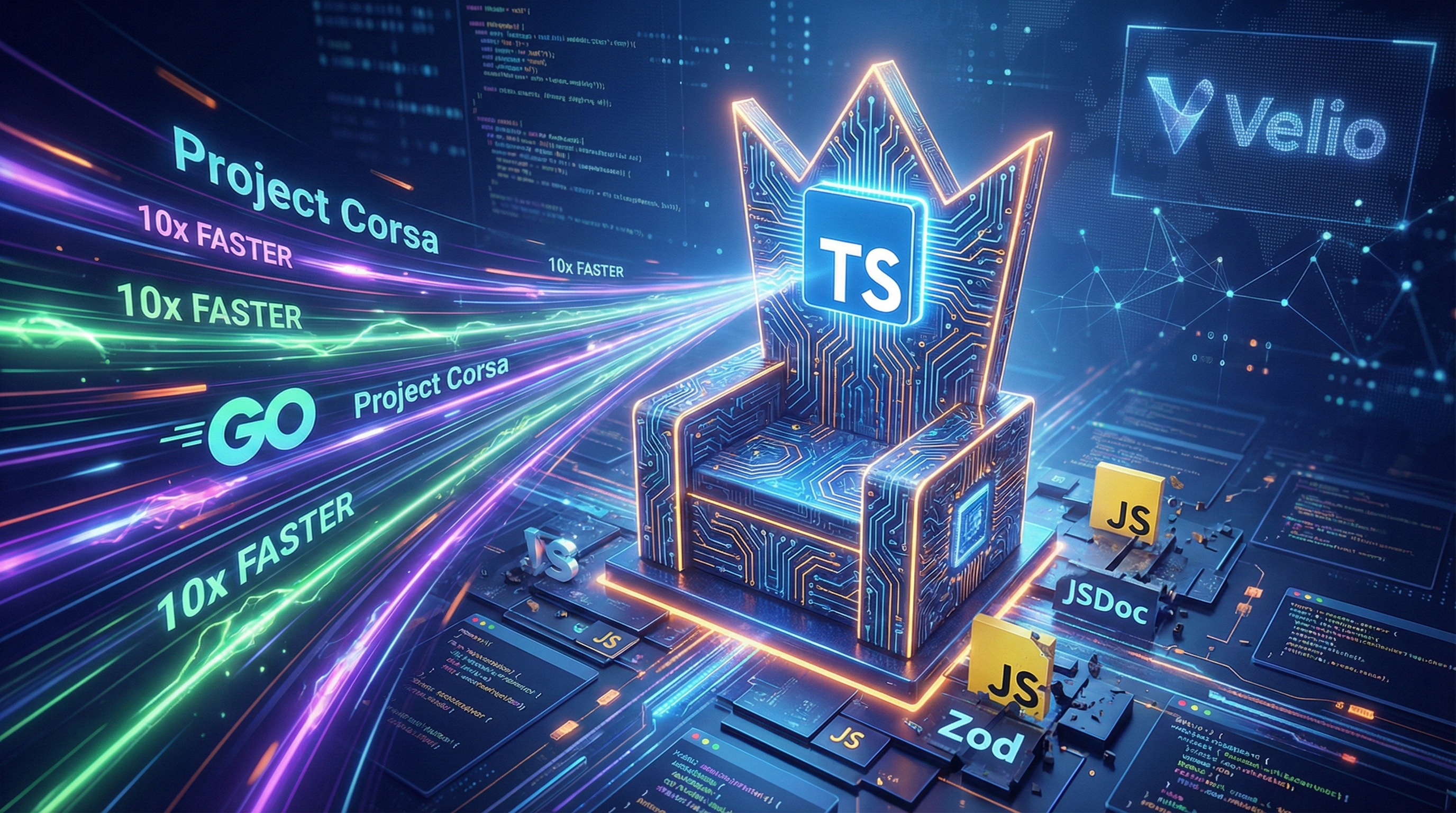
As we head into 2025, TypeScript remains the undisputed titan of web development, commanding a significant "safety premium" in salaries and securing the foundations of enterprise tech. However, with rising developer burnout and a vocal "De-TypeScripting" movement advocating for simplicity, the King’s throne is being challenged. We at Velio dive into the data behind this shift and explore Microsoft’s massive pivot to Project Corsa—a native Go-based compiler designed to make type safety instant, effortless, and "native" once again.
At Velio, we are obsessed with the tools that build our digital world, but we are equally fascinated by the people wielding them. The story of software development is rarely just about code; it is a saga of human efficiency, cognitive load, and the pursuit of a frictionless lifestyle. For the past decade, one technology has sat comfortably on the throne of web development: TypeScript. It promised order in the chaos of JavaScript, safety in the wild west of the web, and a professional sheen to front-end engineering.
But as we settle into 2025, the winds are shifting. We are seeing a fascinating divergence in the ecosystem—a tension between the desire for absolute correctness and the human need for simplicity. Is the "King" secure, or are we witnessing the early tremors of a revolution?
In this deep dive, we explore the massive data sets of 2024 and 2025, the economic realities of developer salaries, and the radical engineering shifts coming from giants like Microsoft. We look at this not just as lines of code, but as a lifestyle choice for the millions of developers who spend their days navigating these systems.
The Quantitative Hegemony: A Portrait of Dominance
To understand where we are going, we must first anchor ourselves in the reality of today. At Velio, we look at the numbers to cut through the hype. The data from late 2024 and early 2025 paints a picture of a technology that has transitioned from a trend into the concrete foundation of modern digital infrastructure.
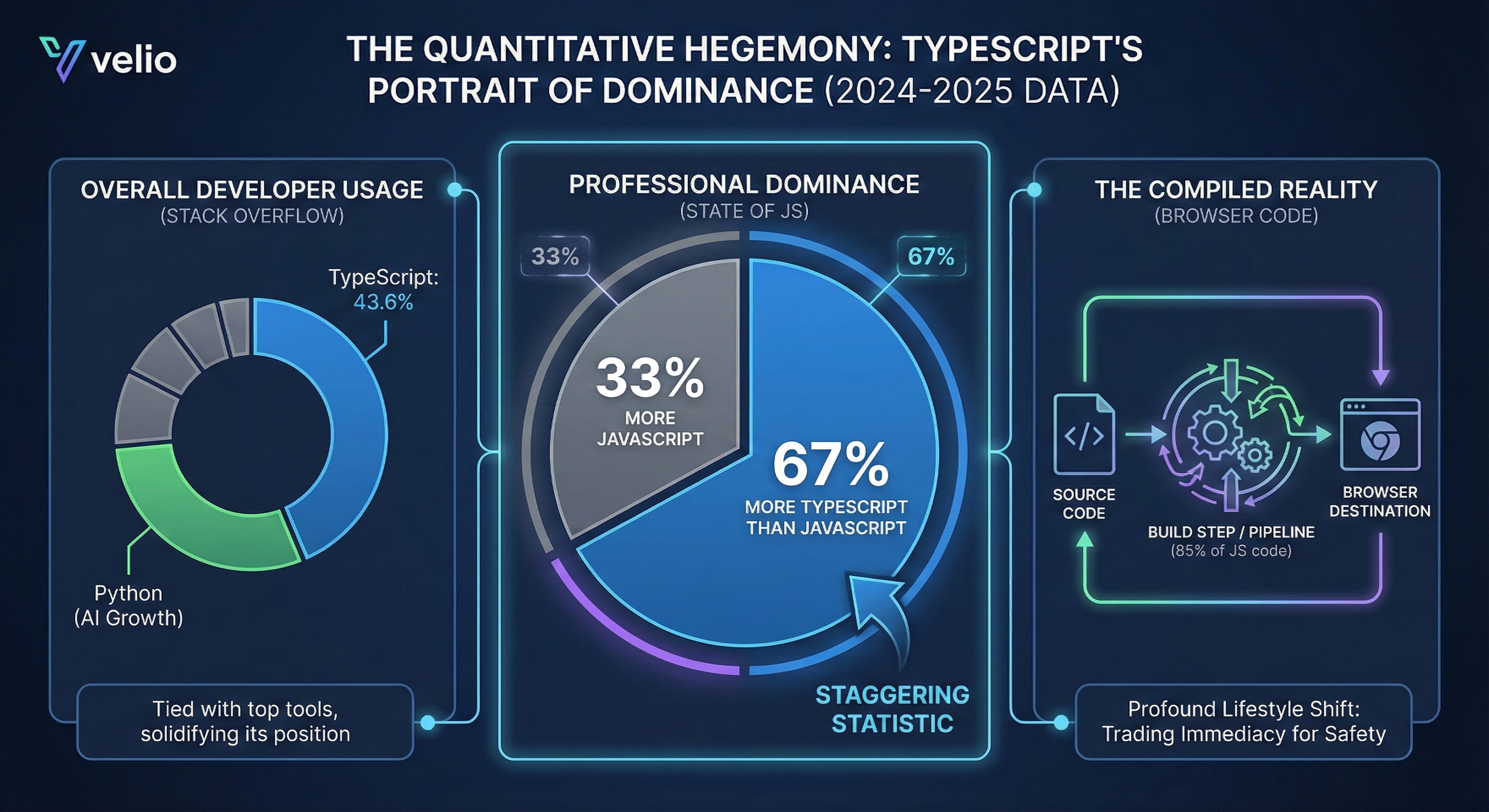
According to the Stack Overflow Developer Survey 2024 and subsequent 2025 data, TypeScript has solidified its position as a top-tier language. While Python has seen explosive growth due to the AI boom, TypeScript maintains a usage rate of 43.6% among all respondents, effectively tying it with the most essential tools of the trade.
The true dominance is revealed among professional developers. The State of JS 2024 survey revealed a staggering statistic: 67% of respondents stated they write more TypeScript than JavaScript code. This shift has created what we call the "Compiled Reality." In 2024, 85% of all JavaScript code destined for the browser went through a build step. This is a profound lifestyle shift; we have traded the immediacy of "save and refresh" for the safety of complex build pipelines.
The Economic Lifestyle: The "TypeScript Premium"
At Velio, we know that technology choices are often career choices. The decision to learn TypeScript is not just about catching bugs; it is about financial upward mobility. The salary data for 2025 demonstrates a persistent and widening "TypeScript Premium," where specialized roles consistently command higher compensation.
The "Safety Premium" Breakdown for 2025:
- Entry-Level Roles: JavaScript developers can expect $66,000 to $90,000, while TypeScript-ready juniors see a 5-10% bump, reaching up to $95,000.
- Mid-Level Engineers: The gap widens here. While standard JS roles range from $90,000 to $120,000, TypeScript proficiency commands $105,000 to $135,000—a 15% premium.
- Senior and Lead Positions: This is the "Seniority Cliff." Senior TypeScript leads are earning between $150,000 and $225,000+, outstripping their pure-JS counterparts by as much as 40%.
- Contract and Specialized Rates: High-demand months in late 2025, driven by the need for complex monorepo management, have seen hourly rates spike between $100 and $200.
Businesses have recognized that while JavaScript is faster for the initial MVP, TypeScript reduces the long-term "Total Cost of Ownership." As long as enterprises value stability, this premium will persist.
The Mental Toll: Tooling Fatigue and Digital Wellness

At Velio, we believe that your tech stack shouldn't ruin your mental health. However, the expansion of the "Type-Safe" ecosystem has come at a psychological cost. "Developer Burnout" has become a critical theme in 2025 research, and it is inextricably linked to the complexity of our tools.
Studies indicate that a staggering 83% of developers report burnout, driven largely by "cognitive overload." TypeScript, for all its benefits, contributes to this load. Features like Generics and Conditional Types can create code that is nearly unreadable to humans, turning the creative act of coding into a high-friction puzzle.
Perhaps most significant is the disruption of "Flow State." Research shows that even micro-delays—waiting 5 to 10 seconds for a recompile—can derail concentration, leading to lower productivity and higher frustration. This is the "hidden tax" of the TypeScript ecosystem: hours lost configuring the compiler rather than shipping code.
The Resistance: The "De-TypeScripting" Movement
It is within this context of fatigue that a vocal counter-movement emerged. Characterized as a "return to simplicity," this movement challenges the necessity of TypeScript’s syntax.
- The Turbo 8 Controversy: David Heinemeier Hansson (DHH), creator of Ruby on Rails, famously removed TypeScript from the Turbo 8 library, arguing that it "pollutes the code with type gymnastics."
- The Svelte Shift: The popular framework Svelte moved its internal codebase to JSDoc. This allowed them to keep type safety without the "build step" friction.
- TC39 "Types as Comments": This proposal aims to allow browsers to ignore type annotations natively. If adopted, TypeScript would cease to be a "language" and become purely a powerful linter.
The Empire Strikes Back: Microsoft’s "Project Corsa"
Microsoft is keenly aware of the complaints regarding build times. In a strategic pivot that changes the game, the TypeScript team announced Project Corsa: a complete port of the TypeScript compiler to Go.
For over a decade, the compiler was written in TypeScript itself. While poetic, this limited performance due to JavaScript’s single-threaded nature. By moving to a native, high-performance language like Go, Microsoft is delivering:
- 10x Improvement in Build Times: Benchmarks show staggering speedups across major codebases.
- 50% Reduction in Memory Usage: Critical for large monorepos that often crash CI/CD pipelines.
- Native Editor Feedback: VS Code load times for massive projects are dropping from nearly 10 seconds to just 1.2 seconds.
This move is a "checkmate" strategy. By eliminating the performance bottleneck, Microsoft ensures that TypeScript remains the most capable tool in the chain, neutralizing the primary argument for "De-TypeScripting."
Conclusion: The King is Dead, Long Live the King
So, will TypeScript always be King?
If "King" means "the exclusive syntax used to write the web," its reign faces threats from native browser proposals. However, if "King" means "the standard for static analysis and developer tooling," its position is unassailable. The transition to Native TypeScript (Project Corsa) in 2025 marks the maturity of the language. It is graduating from a "JavaScript tool" to a "Systems tool."
For the professional developer, the future is typed, the compiler is native, and the feedback is instant. The chaos of the early web has been tamed, and TypeScript wears the crown.
Keep reading
Random picks from across Velio.

Discover how the "AI Co-Parent" is revolutionizing pet care. From smart collars to health-tracking litter boxes, explore the $50B tech trend saving pet lives.

By using inexpensive "smart stickers" (NFC Stickers, the tech inside your credit card), you can create a home that organizes itself.

Discover how transparent solar windows and smart curtains are redefining urban energy in 2026. Explore the "Vertical Power Plant" and the latest BIPV trends from key players like UbiQD and SolarGaps.

2025 marks the end of the "app" era. Explore how Ambient Computing, Large Action Models (LAMs), and neural interfaces are making screens obsolete.

As we move deeper into 2025, a profound inversion is reshaping the technological landscape. The frontier of AI innovation has migrated from distant, massive cloud servers to the in

Meet ElliQ: The proactive AI companion fighting senior loneliness. Discover how social robotics and 'invisible' tech are redefining independence for the 100-year life.

As we close out 2025, the landscape of budget PC building has shifted dramatically. Two years ago, "budget" meant compromising on core counts or being stuck on dead-end platforms.
Why 60Hz is obsolete in 2026. Discover how 144Hz displays reduce eye strain, boost productivity, and why gaming tech is now the essential office health standard.

Stop monetizing hobbies. Discover why "strategic uselessness" and active recovery are the real cures for burnout. Hack your 5-to-9 routine for healing, not just hustling.