

The Death of the Interface: Why the Best Tech of 2025 is Invisible


The Philosophy of Invisibility
The core tenets of Calm Technology, which now underpin the design of 2025's ambient systems, are:
- Peripheral Attention: Technology must shift smoothly between the center of attention and the periphery. It should inform without demanding focus. A smart home system that adjusts the lights based on time of day works in the periphery; a phone notification that buzzes and lights up demands central focus.
- Increasing Peripheral Use: By engaging the periphery—through auditory cues, ambient light, or haptic feedback—technology prevents cognitive overburdening. This creates a pleasant user experience by not "overheating" the user's attentional capacity.
- Familiarity and Context: Systems must rely on a sense of familiarity, understanding the user's past, present, and future context to function intuitively. A calm system knows you are home not because you opened an app to tell it, but because it sensed your arrival.
The history of human-computer interaction (HCI) can be categorized by the proximity of the interface to the user's intent and the friction required to execute it.
- The Mainframe Era (Remote): Interaction was scarce, specialized, and physically removed from the user. Computing was an event one went to, not a layer one lived in.
- The Personal Computing Era (Explicit): Interaction became one-to-one. The user sat in front of a box and issued explicit commands via CLI or GUI. The computer was a tool that did nothing until told.
- The Mobile Era (Continuous/Intrusive): Interaction became continuous but remained explicit. Users carried the computer (smartphone) everywhere, but every action required unlocking, navigating an OS, opening an app, and tapping. This era was defined by "using" technology.
- The Ambient Era (Implicit/Anticipatory): Commencing roughly in 2025, interaction becomes implicit. The computer "lives out here in the world with people". It anticipates needs based on context (location, biometrics, time, history) and executes outcomes.
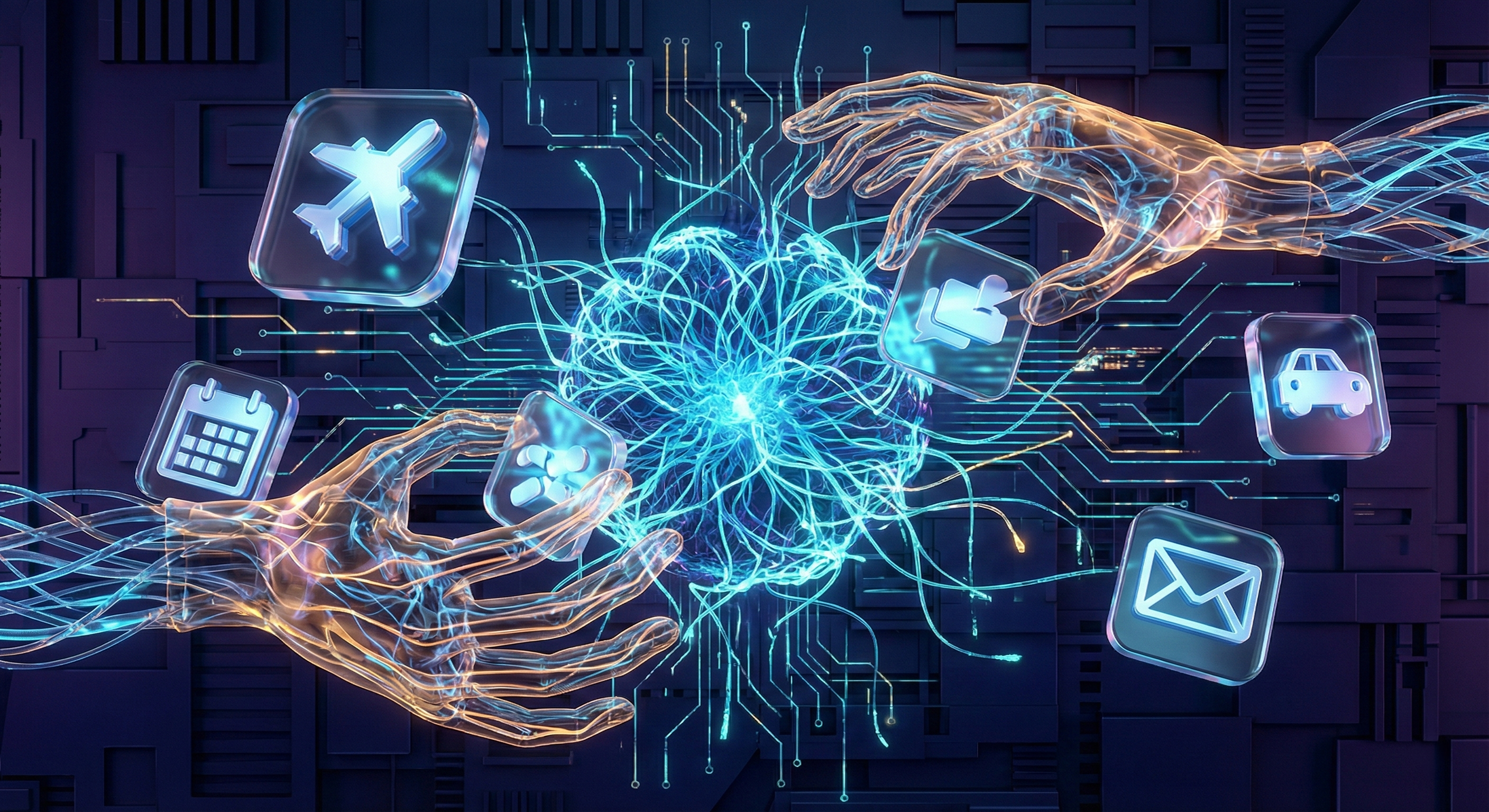
The Brains - From Large Language Models to Large Action Models
The sophistication of LAMs in 2025 lies in their multi-layered architecture, which often employs a "neuro-symbolic" approach. This combines the neural network's ability to understand vague natural language commands with symbolic logic planners that can verify steps.
- Large Language Model (LLM): Text, Code, Images
- Large Action Model (LAM): API Calls, UI Clicks, Robotic Control
- LLM: Information Processing & Generation
- LAM: Task Execution & Decision Making
- LLM: Conversational / Passive
- LAM: Agentic / Active
- LLM: Transformer-based (Next Token Prediction)
- LAM: Neuro-Symbolic (Intent to Action)
- LLM: Static Text/Data Context
- LAM: Dynamic Digital & Physical Worlds
- LLM: "Write a travel itinerary for Tokyo."
- LAM: "Book the flights, hotel, and dinner reservations."
- LLM: Minimal (Conversation context only)
- LAM: High (Real-time error correction, self-healing)
The sophistication of LAMs in 2025 lies in their multi-layered architecture, which often employs a "neuro-symbolic" approach. This combines the neural network's ability to understand vague natural language commands with symbolic logic planners that can verify steps.
- Semantic Understanding Layer: Usually a Transformer-based model that parses the user's natural language request to extract intent and parameters (e.g., "Order me a ride to the office" -> Intent: Ride Share, Destination: Office).
- Logic Planning Layer: A symbolic reasoning engine that transforms the intent into a sequence of actions. This layer is crucial for "multi-hop" reasoning—solving problems that require navigating through multiple screens or applications. For example, a LAM booking a trip might need to check a calendar, then find a flight, then email a confirmation. The planner ensures these happen in the correct logical order.
- Execution Coordination Layer: This layer interfaces with the digital world. Crucially, LAMs can be trained to "see" User Interfaces (UI) directly. They identify buttons, text fields, and dropdowns visually, mimicking human interaction. This allows them to operate legacy apps that have no public API, a capability famously marketed by Rabbit's R1 OS.
- Feedback Layer: The LAM monitors the result of its action. If a button click fails or a page loads slowly, the system adapts in real-time, a capability known as "self-healing" or dynamic adaptability. Unlike an RPA script that breaks if a button moves, a LAM "looks" for the button's new location.
This architecture enables the "Competence Inversion" mentioned earlier. By standardizing complex workflows into repeatable, error-checked action sequences, LAMs reduce the variability and bias inherent in human execution. They are the engine of the ambient world, turning the "request" into the "result" without the user needing to touch the screen.

The Body - Agentic Hardware and the Physical World
- Latency: It relied almost entirely on cloud processing. Every command had to be sent to a server, processed, and returned, resulting in multi-second delays that broke the illusion of "ambient" conversation.
- Thermal Issues: The device frequently overheated, becoming uncomfortable to wear.
- Ecosystem Isolation: It lacked deep integration with the apps users actually relied on.
- Outcome: By February 2025, Humane's assets were acquired by HP for $116 million—a fraction of its $850 million valuation—marking the end of the experiment. The remaining units were set to stop working by the end of that month.
- Why this matters: It solves the "social friction" of voice commands. Using voice to read a text message in a quiet meeting, a library, or a crowded train is socially unacceptable. The Neural Band allows for silent, discrete interaction—clicking, scrolling, and even typing—without lifting a hand or speaking a word. This is the closest realization of "telepathic" control in consumer tech, bridging the gap between intent and action with near-zero latency.
- Implication for Ambient Computing: High brightness allows visibility outdoors; monocular design saves battery and reduces distraction.
- Implication for Ambient Computing: Enables "invisible" input via motor neuron signals; solves the social stigma of voice control.
- Implication for Ambient Computing: Glasses "see" and "hear" context (e.g., translation, object ID) without prompt.
- Implication for Ambient Computing: All-day wearability ensures the device is always present (Ambient).
- Implication for Ambient Computing: Allows digital audio to blend with physical sound; "Conversation Focus" amplifies speakers.
- Implication for Ambient Computing: Lightweight form factor enables continuous wear, critical for ambient adoption.
A "World Model" differs from a language model in that it understands physics, causality, and temporal continuity. It simulates outcomes before they happen.
- Cosmos Predict: Generates video predictions of future states (e.g., if a robot drops a glass, it breaks). This allows agents to plan complex physical tasks by visualizing the outcome before acting.
- Cosmos Reason: A reasoning engine that allows robots to act with "common sense" in unstructured environments (e.g., identifying a spill and deciding to clean it up without being explicitly programmed for that specific liquid).
- Cosmos Transfer: Enables the creation of synthetic training data, taking 3D simulations and turning them into photorealistic video to train robots safely in a digital twin before they enter the real world.
The Nervous System - Protocols and Interoperability
- Workflow: A user asks their Personal Agent to "hire a graphic designer." The Personal Agent broadcasts a discovery request via A2A. A specialized Design Agent responds with its portfolio and rate. The two agents negotiate, execute the contract, and deliver the work without human mediation.
- Interoperability: It is built on standard HTTP and JSON-RPC, making it compatible with existing web infrastructure. It solves the "silo" problem where an AI agent was previously trapped within the application that created it.
- Mechanism: MCP defines a client-server lifecycle (Initialization -> Operation -> Shutdown) where applications can expose their data to AI assistants securely. This effectively allows an AI to "read" the user's entire digital life (files, chats, logs) through a standardized interface.
- The Browser as OS: The "Death of the Interface" is also the death of the website as a destination. Agentic browsers read websites for the user. Features like "Deep Research" in Sigma or "Comet Agent" in Perplexity navigate multiple tabs, scrape data, synthesize findings, and fill out forms automatically.
- Perplexity Comet: Often cited as the most advanced "autonomous" browser, it includes features for "Deep Research" where it clusters information from multiple sources to generate structured insights, effectively automating the role of a junior research analyst.
- Dia (Arc): Following the acquisition of The Browser Company by Atlassian for $610 million, Dia integrates AI directly into the URL bar, offering "tab-aware intelligence" that can synthesize data across all open tabs.
This shift necessitates a change in the economic model of the web. If an AI agent reads a news site to summarize it for the user, the user never sees the ads. This "Cometjacking" of content has sparked a crisis in ad-supported media models, pushing the web toward subscription and API-access economies.

The Habitat - Ambient Intelligence in Homes and Cities
- Context-Aware Climate: Instead of a fixed schedule, an agentic HVAC system checks the user's location (via car GPS) and biometric stress levels (via smart watch). If the user is driving home in a high-stress state, the home prepares a calming lighting scene and optimal temperature.
- Grid-Interactive Intelligence: Homes now actively participate in the energy grid. Agentic AI optimizes battery use by forecasting solar generation and utility rates, autonomously selling power back to the grid during peak pricing windows without user input. This turns the home from a passive energy consumer into an active market participant.
- Adaptive Infrastructure: Traffic lights that adjust timing based on real-time computer vision analysis of pedestrian density (using technologies like Nvidia Cosmos to predict flow).
- Healthcare: Ambient sensors in hospitals monitor patient vitals without wires (using radar/UWB), detecting deterioration trends that a human nurse might miss during spot checks. This "invisible monitoring" extends to the home, where predictive models can alert users to health issues (like heart strain or sleep disorders) before symptoms even appear.
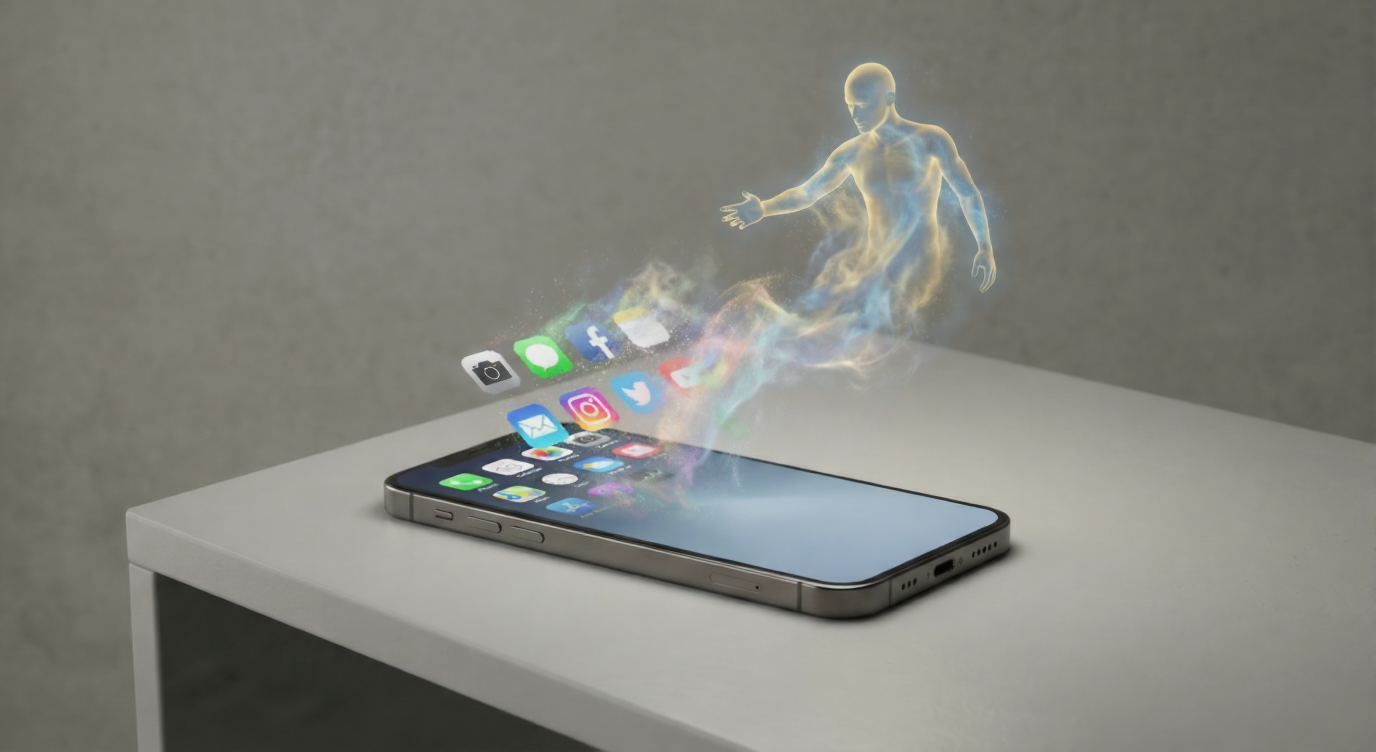
The Economic Realignment - Monetization and the End of Apps
The shift to Ambient Computing is an existential threat to the "App Store" economy. When interaction moves from "tapping an icon" to "stating an intent," the app as a visual container becomes obsolete.
- The Headless Future: In an agentic world, brands do not need a visual UI; they need a robust API. If a user says "Order me a ride," the AI agent chooses the service (Uber, Lyft, Waymo) based on price and speed, not brand loyalty or app design. This commoditizes the service provider.
- Brand Invisibility: Marketing shifts from "Zero UI" to "Zero Click." Brands must optimize for "Agentic SEO"—ensuring their products are discoverable and trusted by the AI agents making decisions on behalf of humans. A brand's success depends less on website design and more on whether it is "machine-readable".
- The Funnel Collapse: The traditional marketing funnel (Awareness -> Consideration -> Conversion) collapses. Agents anticipate needs and fulfill them instantly. Presence is earned through anticipation, not visibility.
If users aren't downloading apps or seeing ads, how is money made? The economy is shifting toward "Service-as-a-Software" and outcome-based pricing. The pricing landscape has crystallized around four fundamental frameworks.
- Description: Flat monthly fee per "digital employee." Competes with HR budgets, not IT budgets.
- Target Use Case: Customer Service, SDR, Data Entry.
- Example: $1,500/mo for a Sales Agent (e.g., 11x AI).
- Description: Pay only for successful results (e.g., meeting booked, ticket resolved).
- Target Use Case: Lead Gen, Support.
- Example: $2.00 per resolved query (Salesforce Agentforce).
- Description: Bundled price for a complex, multi-step process.
- Target Use Case: Recruitment, Legal Review.
- Example: $500 per qualified candidate found.
- Description: Pay per API call or compute minute.
- Target Use Case: Developer Tools, Infrastructure.
- Example: Token-based pricing.
This shift is particularly impactful for the Indian IT sector (TCS, Infosys, Wipro). These giants are pivoting from "staff augmentation" (renting humans) to "agent augmentation" (renting outcomes). Revenue growth is now driven by deploying autonomous agents that do the work of 10 humans for the price of one, fundamentally altering their business model from "time and materials" to "value delivered".

The Cost - Ethics, Psychology, and Society
- The Paradox: Cognitive offloading increases short-term efficiency but causes long-term skill erosion. Just as GPS weakened human spatial memory, agentic AI threatens "executive capability." If an AI always negotiates your schedule, writes your emails, and summarizes your reading, your ability to perform these tasks independently atrophies.
- The Four Stages of Decay: Researchers have identified a progression:
- Exploration: Curiosity and convenience.
- Integration: AI becomes part of the workflow.
- Reliance: AI is critical; human skill begins to fade.
- Addiction: Inability to function effectively without AI assistance.
"Zero UI" is synonymous with "Total Surveillance." For a home to be truly predictive, it must watch and listen constantly.
- Privacy in a Sensor-Rich World: The use of UWB, facial recognition, and constant audio monitoring creates a digital panopticon. Unlike a phone, which can be put away, ambient sensors are embedded in the infrastructure—light bulbs, thermostats, walls.
- Security Vulnerabilities: "Touchless" interfaces introduce new attack vectors. Biometric data (face, gait, voice) can be spoofed or stolen. Once a biometric key is compromised, it cannot be reset like a password.
- Identity and Deepfakes: The ability to replicate human identity (voice, face) has led to a crisis of trust. In India, deepfake technology has been used to reconstruct identities for fraud, not by stealing data, but by synthesizing it. This challenges legal frameworks like the DPDP Act, which protect data but not digital personhood.
Sociologically, the elimination of friction removes the "serendipity" of life. Automated shopping, automated dating, and automated scheduling create "filter bubbles" in the physical world.
- Class Divides: A divide is emerging between those who can afford "human" interaction and those served by agents. Ironically, human service becomes the luxury good, while the masses are served by efficient, invisible AI agents.
- The "Human-in-the-Loop" Liability: By late 2025, the narrative shifted to viewing human intervention as a "liability" or bottleneck. Systems are being designed to exclude humans to maintain speed and accuracy, raising fundamental questions about human agency in a mechanized world.
- Workforce Disruption: As AI agents replace "knowledge work" tasks (coding, writing, analysis), entire sectors face an existential crisis. The shift is from "using tools" to "supervising agents," requiring a massive reskilling of the workforce toward strategy and oversight rather than execution.

The Era of "Living Intelligence"
However, this invisibility comes at a price. It demands a surrender of control to algorithms that operate in the background, a potential atrophy of human cognitive skill, and an acceptance of pervasive surveillance as the cost of convenience. As we move into 2026, the challenge for developers, policymakers, and users is no longer "How do we make the interface better?" but "How do we retain our humanity when the interface disappears?"
The screen is dead. Long live the Agent.
Keep reading
Random picks from across Velio.
Is TypeScript losing its crown? Explore the 2025 dev landscape, rising salaries, developer burnout, and Microsoft’s 10x faster Go-based "Project Corsa."

Meet ElliQ: The proactive AI companion fighting senior loneliness. Discover how social robotics and 'invisible' tech are redefining independence for the 100-year life.

As we move deeper into 2025, a profound inversion is reshaping the technological landscape. The frontier of AI innovation has migrated from distant, massive cloud servers to the in

By using inexpensive "smart stickers" (NFC Stickers, the tech inside your credit card), you can create a home that organizes itself.
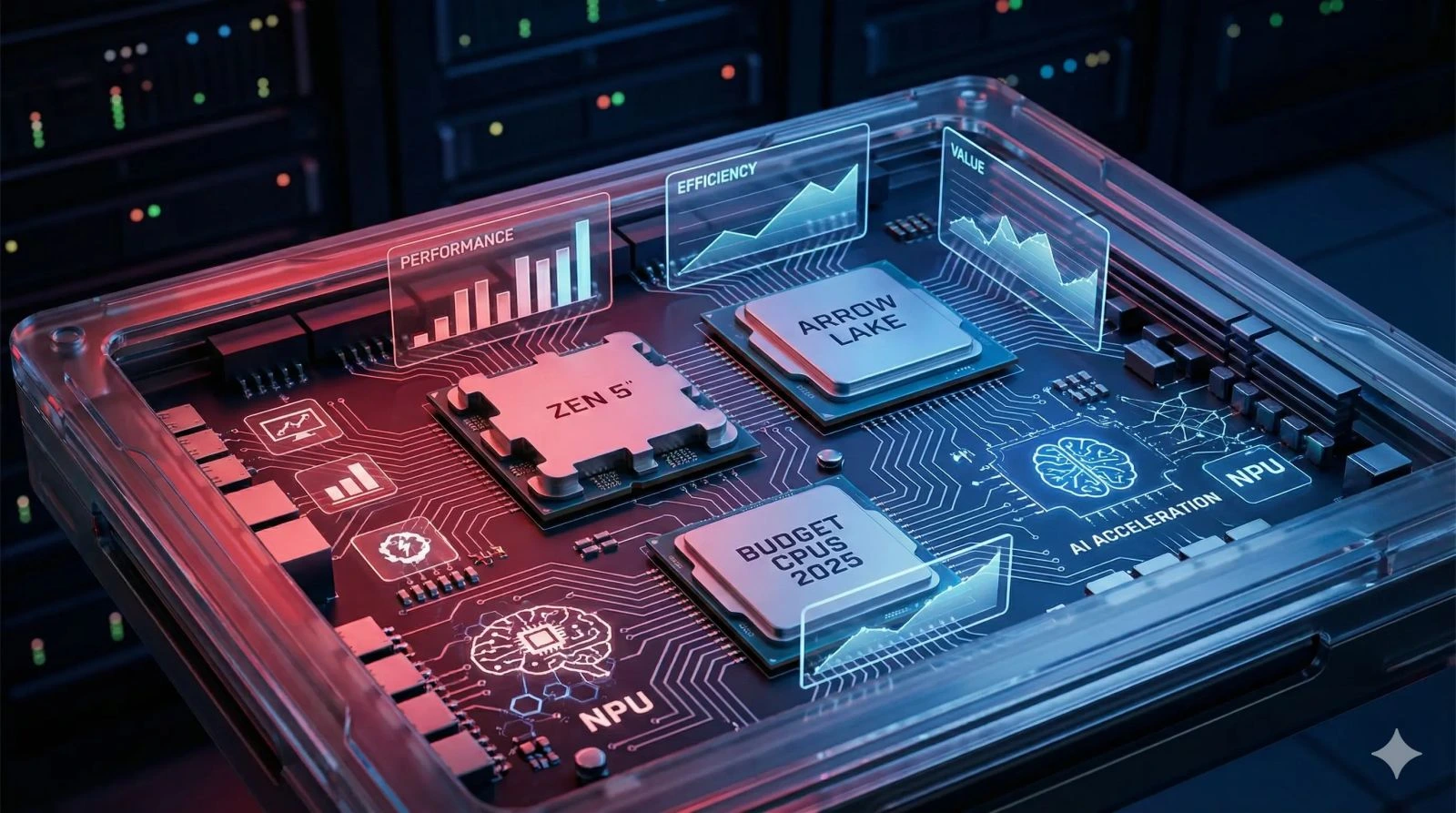
As we close out 2025, the landscape of budget PC building has shifted dramatically. Two years ago, "budget" meant compromising on core counts or being stuck on dead-end platforms.
Why 60Hz is obsolete in 2026. Discover how 144Hz displays reduce eye strain, boost productivity, and why gaming tech is now the essential office health standard.

Discover how transparent solar windows and smart curtains are redefining urban energy in 2026. Explore the "Vertical Power Plant" and the latest BIPV trends from key players like UbiQD and SolarGaps.

Discover how the "AI Co-Parent" is revolutionizing pet care. From smart collars to health-tracking litter boxes, explore the $50B tech trend saving pet lives.

Stop monetizing hobbies. Discover why "strategic uselessness" and active recovery are the real cures for burnout. Hack your 5-to-9 routine for healing, not just hustling.